
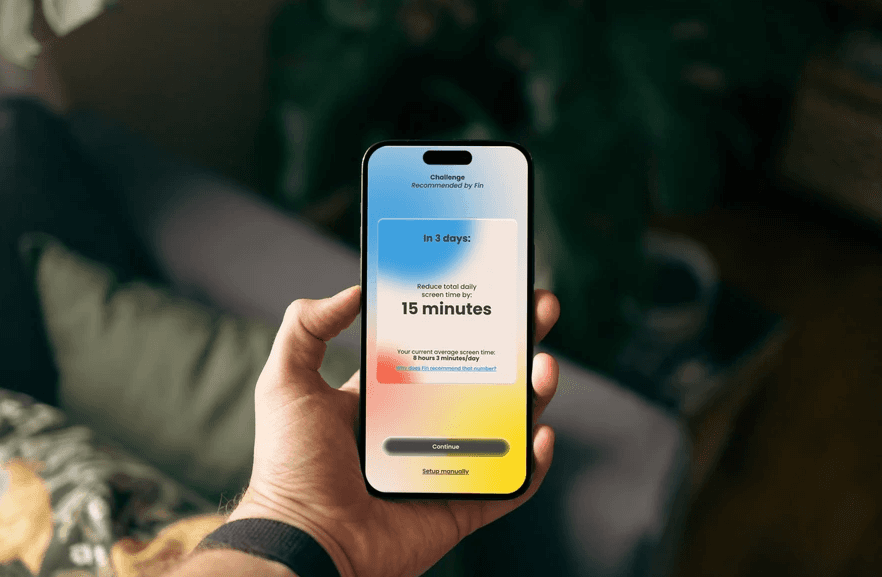
Reframing the Digital Detox experience: From Restriction to Growth
Industry:
Health & Wellness
Project type:
UX Research
UX Design
UI Design
Role:
UX Designer
UI Designer
Deliverables:
Design system
Wireframe
Hi-fi prototype
Timeline:
4 months
Problem:
Solution:
Fin is a gamified digital detox application that nutures willpower with structure, turning the detox process into a supported journey of habit-building through gamified challenges, a real-life rewards system, and an AI assistant that acts as a humorous, personalised companion.
Process:
Approach
Research
Concept Development
Iterating
& Refining
Final Prototype
Outcomes
& Reflections
Approach
Growing up in an increasingly connected world, I found myself struggling to control my own screen time, and wondering whether this was a personal failing or something far more widespread.
It turned out that problematic internet use and excessive screen time are inevitable byproducts of the modern digital revolution - academic literature documents the consequences extensively. Despite the growing number of and digital detox methods and applications, the problem persists. That gap became the starting point for this project.

Research
2.1. Survey
To test this further within a specific and underexplored context, I conducted a survey in Vietnamese, among 142 Vietnamese participants aged 30 and under via Google Form, targeting regular users of digital devices, social media, and mobile applications.

admit to frequent phone checking - work, study, or pure boredom
believe reducing screen time would free up time for meaningful activities
want timed focus sessions feature, more than double the 31.5% who want apps blocking
prioritised social connection, ranking second, above all blocking features
Self-dropout: participants anticipated deleting the app when motivation dropped
2.2. Competitors Analysis
Three of the most prominent apps in the digital detox field - Forest, Opal, and JOMO - represent distinct approaches that reflect the evolution of digital detox thinking over time.
To go deeper, I conducted a SWOT analysis on each of them. Hover your mouse to each icon to see it.


Key findings:
None of the three apps offer personalised, redeemable real-world rewards. The benefit of reducing screen time remains entirely on-screen.
Gamification is inconsistent across all three: present but limited to a single mechanic in Forest, layered on top of blocking in Opal, and absent in JOMO. This creates a gap for users who need tangible external motivation to sustain commitment.
Concept Development
2.1. Design Direction
From the insights collected through the Survey and Competitors Analysis, I came up with 3 design solutions:
Gamification
Real-life vendor collaboration
AI assistant with human-like traits
2.2. The core mechanisms
The app is built around four core mechanisms, grounded in the 3 design solutions. Mapping their user flows reveals how the app's features interconnect, and how each one supports the user at a different stage of the detox journey.

2.3. Concept
The root "FIN" in Latin means "end" and "limit". In Vietnamese it was pronounced as "Phin" - the same way we pronounce our traditional drip coffee filter. Coffee brewed through a phin cannot be rushed. That patience is Fin's philosophy: digital detox is not about abrupt stopping, but slowing down deliberately.
The visual identity draws from the same cultural roots: the phin filter's quiet simplicity and the cheerful polka-dot glasses of Vietnamese households.

Iterating & Refining
Following the design solutions and 4 core mechanisms, I created a low fidelity prototype. The initial prototype exposed a hierarchy problem: too much information at equal visual weight, creating cognitive overload at the app's entry point. The home screen was redesigned to surface the most critical information first, with secondary data accessible on demand.

Final design

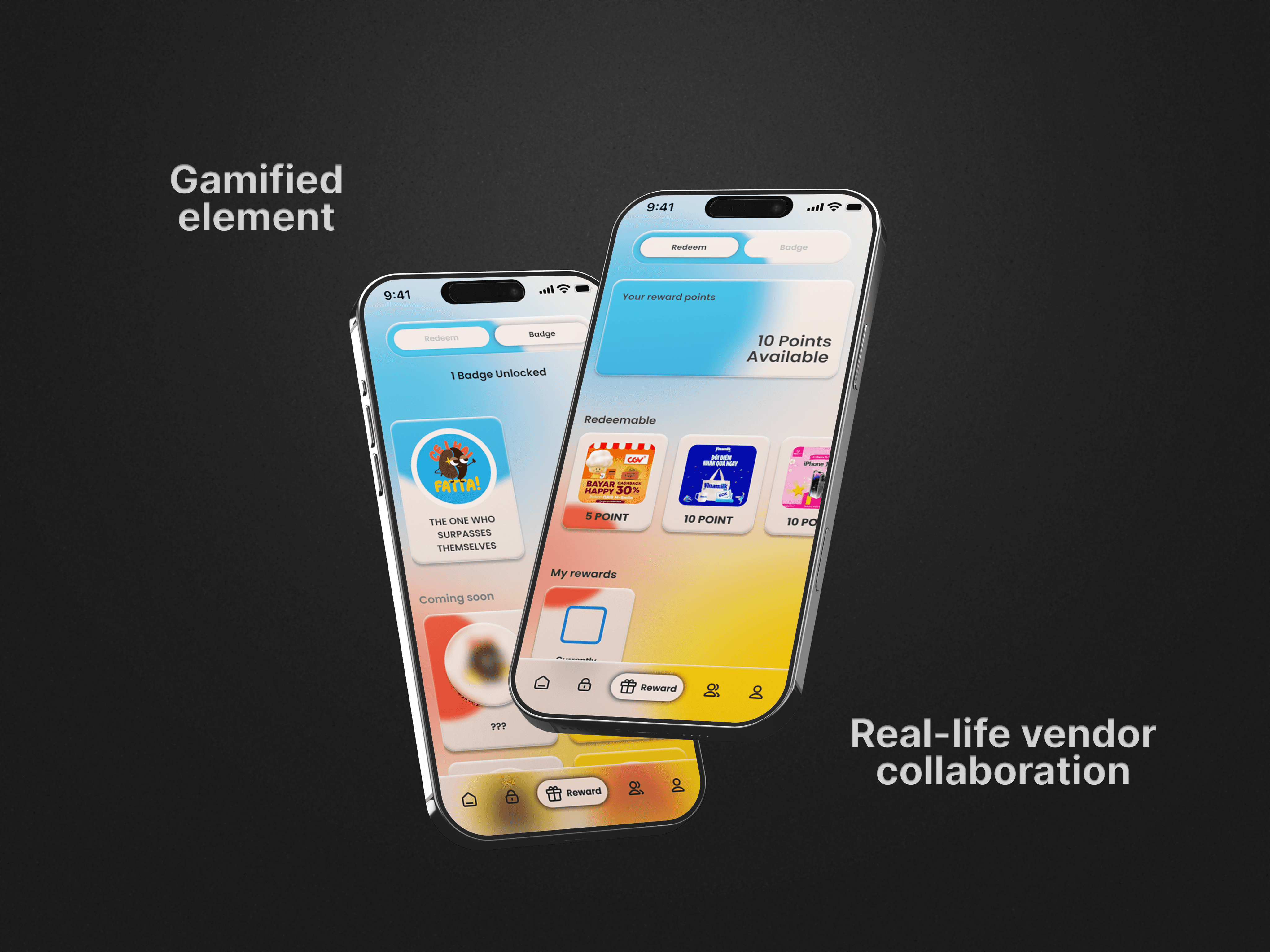
Try Fin out by interacting with the prototype below:
Outcomes & Reflection
Key Outcomes
Research-validated concept: The researches directly informed the app's core mechanics, confirming both the problem space and user appetite for gamification.
Complete UX foundation: I mapped the full user journey across 4 core mechanics, producing user flows, wireframes, and a mid-fi prototype covering the key interactions.
Culturally grounded design identity: I developed a visual and conceptual identity rooted in Vietnamese culture.
Real-world reward system as an ecosystem opportunity: this points to a larger vision: Fin as part of a well-being ecosystem adopted by schools, companies, and local businesses, where reducing screen time creates value beyond the individual, connecting digital health to productivity, community, and local economy.
Reflections:
Ambitious scope for a solo project: I took on research, UX strategy, interaction design, and UI execution within 4 months. This is a workload that in hindsight would have benefited from a small team working together.
UX stronger than UI: the UI lacks a fully developed design system beyond typography and a handful of reusable components.
What I would do next time: establish a component library and visual system, or collaborate with a dedicated UI/visual designer to ensure consistency across the full product.

This design project exemplifies how I can benefit your business.
Contact me if you’re interested in collaborating!
Or email me vananh.vivian.ha@gmail.com
See more projects:
